B. Pharmacy 8th Semester Important Questions

8th Semester Important Questions

B. Pharmacy 8th Semester All Subjects Important Questions Expect These Questions Short: Definitions, lists, brief explanations.Long: Explaining methods, case studies (marketing, drug safety), public health programs.Calculations: Likely in stats, maybe in marketing.Critical Thinking: Analyze research, ethics, proposing solutions. SOCIAL AND PREVENTIVE PHARMACY Social & Preventive Pharmacy: Public health, preventing disease, health campaigns, pharmacist’s role. BIOSTATICS … Read more
B. Pharmacy 7th Semester Important Questions

B. Pharmacy 7th Semester Important Questions

B. Pharmacy 7th Semester All Subjects Important Questions Question Types: Short Answer: Definitions, pros/cons of techniques, brief explanations. Long Answer: Explain instruments, processes, analyze patient cases. Applied: Interpret data, design drug delivery, calculations. INDUSTRIAL PHARMACY – 2 Industrial Pharmacy II: Scale-up, making tablets/capsules, liquid/injectable forms, quality control. INSTRUMENTAL METHOD OF ANALYSIS Instrumental Methods of Analysis: … Read more

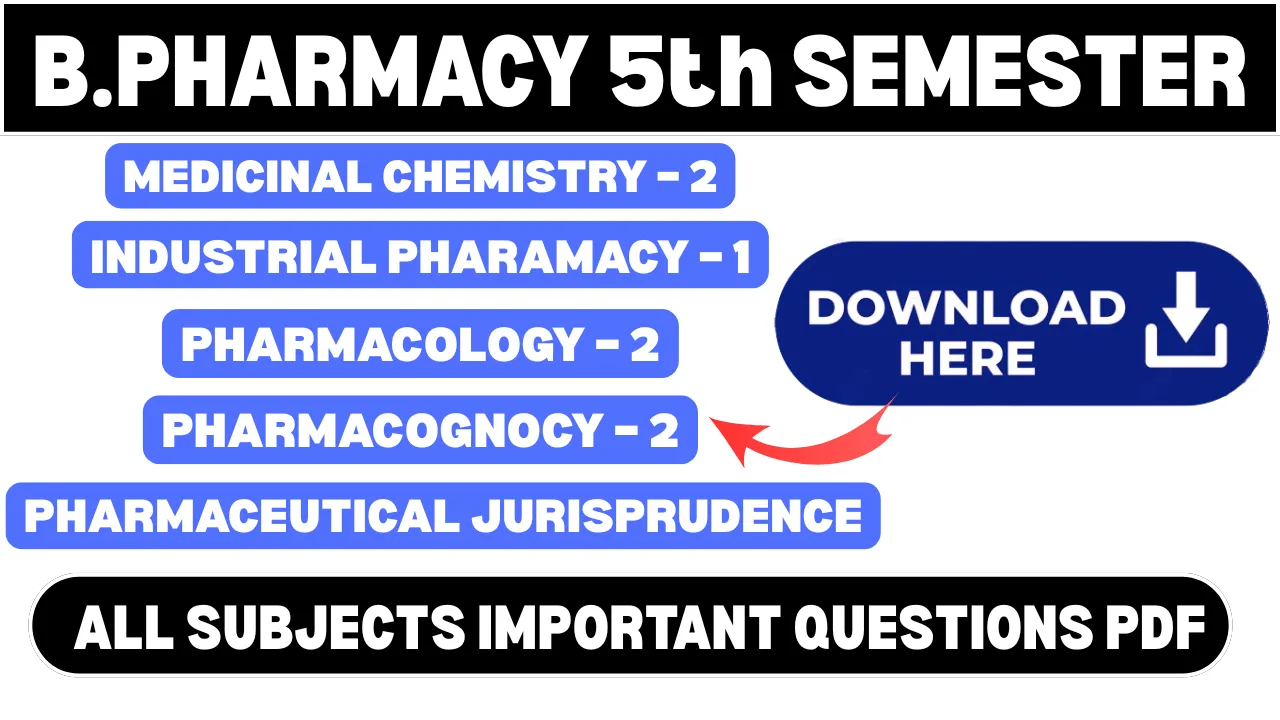
B. Pharmacy 5th Semester Important Questions

B. Pharmacy 5th Semester Important Questions

B. Pharmacy 5th Semester All Subjects Important Questions MEDICINAL CHEMISTRY – 2 Medicinal Chemistry 2: Design drugs, understand how they interact with the body, and predict how they’ll be broken down. Be ready to analyze the relationship between a drug’s chemical structure and its activity. PHARMACEUTICAL JURISPRUDENCE Pharmaceutical Jurisprudence: Examine the laws and ethics of … Read more

B. Pharmacy 3rd Semester Important Questions

B. Pharmacy 3rd Semester Important Questions

B. Pharmacy 3rd Semester All Subjects Important Questions PHARMACEUTICAL MICROBIOLOGY Pharmaceutical Microbiology: Studies microorganisms, including bacteria, fungi, and viruses, and their significance in pharmaceutical settings. PHARMACEUTICAL ORGANIC CHEMISTRY – 2 Pharmaceutical Organic Chemistry II: Focuses on the chemistry of organic compounds with medicinal applications. PHYSICAL PHARMACEUTICS – 1 Physical Pharmaceutics I: Explores the physical and … Read more

B. Pharmacy 1st Semester Important Questions

B. Pharmacy 1st Semester Important Questions

B. Pharmacy 1st Semester All Subjects Important Questions Key Focus Areas: Human Anatomy and Physiology-I: Focus on cells, tissues, the skeletal system, cardiovascular system, blood, and the lymphatic system. Pharmaceutical Analysis : Master titrations (acid-base, redox, etc.), pharmaceutical calculations, and isotonic solutions. Pharmaceutics-I: Understand dosage forms (solid, liquid, semisolid), the history of pharmacy, and pharmaceutical … Read more

Human Anatomy And Physiology 1 | Unit 3

UNIT – 3 Human Anatomy And Physiology 1 | Unit 3 focuses on body fluids, blood, and the lymphatic system—topics that form a high-weightage foundation for B.Pharmacy semester examinations and multiple competitive pharmacy exams. This unit is critically important for GPAT preparation because questions related to blood composition, hemoglobin formation, anemia, coagulation mechanisms, blood grouping, … Read more

Pharmaceutics 1 – Unit 4 | Imperfect Pharmacy Notes

UNIT – 4 About This Unit (Pharmaceutics 1 – Unit 4 | Imperfect Pharmacy Notes) Pharmaceutics 1 – Unit 4 focuses on two highly examinable and concept-driven areas of pharmaceutical sciences: suppositories and pharmaceutical incompatibilities. This unit forms a critical foundation for B.Pharmacy semester examinations and is repeatedly tested in GPAT preparation, Drug Inspector exam, … Read more

Human Anatomy And Physiology 2 | Unit 1

 Unit 1  Nervous System: Organization of nervous system, neuron, neuroglia, classification and properties of nerve fibre, electrophysiology, action potential, nerve impulse, receptors, synapse, neurotransmitters. Central nervous system: Meninges, ventricles of brain and cerebrospinal fluid. structure and functions of brain (cerebrum, brain stem, cerebellum), spinal cord (gross structure, functions of afferent and efferent nerve tracts, reflex … Read more

Human Anatomy And Physiology 2 | Unit 2

 Unit 2  Digestive system: Anatomy of GI Tract with special reference to anatomy and functions of stomach, ( Acid production in the stomach, regulation of acid production through parasympathetic nervous system, pepsin role in protein digestion) small intestine and large intestine, anatomy and functions of salivary glands, pancreas and liver, movements of GIT, digestion and … Read more

Human Anatomy And Physiology 2 | Unit 3

 Unit 3  Respiratory system: Anatomy of respiratory system with special reference to anatomy of lungs, mechanism of respiration, regulation of respiration. Lung Volumes and capacities transport of respiratory gases, artificial respiration, and resuscitation methods. Urinary system Anatomy of urinary tract with special reference to anatomy of kidney and nephrons, functions of kidney and urinary tract, … Read more

JOIN NOW